In a world crowded by social media, artificial intelligence, and depolarization, I've been drawn to stories and work centered on authenticity and connection that cut through the noise.
I'm an Indianapolis-based creative producer with a focus on visual storytelling and a passion for narratives that empower marginalized voices. I've interviewed and worked with refugees from the Democratic Republic of Congo, Ukraine, Myanmar, Haiti, and Afghanistan; child trafficking and child abuse survivors; and temporarily unhoused tenants suffering from predatory practices by landlords. I've led and produced top-to-bottom rebrands and various multimedia campaigns.
Thank you for taking the time to check out my work, and I look forward to hearing from you!


We, Hoosiers
A Storytelling Project for a United Indiana
A concept project I designed to build bridges and trust between Hoosiers by forming a new shared identity based on shared values rather than demographic or political differences. The project paired in-person storytelling events with a digital infrastructure that would archive and disseminate real Hoosier stories across county lines.
I interviewed and wrote creative pieces told in first-person about several Hoosiers from different cultural backgrounds. For each, they told a story of an important moment in their life that has shaped some of their most important values.
Brand and Creative Direction - André Guima
Logo Design - Jake Wheatley
Writing - André Guima
Video Production - Tilt 23 Studios
Web Design & Additional Illustrations - André Guima


"We, Hoosiers" storytelling event in Evansville, IN. Participants shared stories in small groups and connected with their neighbors.


A Hoosier since 1960s
I’m just going to say this, it feels weird to say: my dad was a banker. We had a big house, a pool, and all the things. I didn’t really know what life outside of that white, suburban, and wealthy lifestyle was like until the third grade, when I attended public school and met Chanley.
At the time, Chanley was my best friend, but we could not have come from more different backgrounds. She lived in a humble apartment above her family’s grocery store in a “bad part of town,” according to my parents. She was from Laos (a Southeast Asian country) and spoke a foreign language at home (I assume it was Lao).
Although I am enormously grateful for my upbringing and how well my parents provided for me, I was jealous of Chanley in many ways. She had more freedom to choose what she wore, who she hung out with, and where she could hang out, and really tight-knit bonds with a community.
For the three years I spent in a public school system, I walked to school and sat next to an extremely diverse group of kids, Jewish, Black, Mormon, and Laotian, among many others. To this day, this time is one of the most memorable of my childhood that has inspired my passions and work as an adult.


A Hoosier since 1960s
Two weeks before his death, my dad and I had one of those conversations where we both knew it would be the last. My dad, Michael Joseph Corcoran, was 83 years old, and his body was riddled with cancer. I used that opportunity to try to make sense of his life’s journey and the two versions of him I knew: one I called “dad,” an empathetic and charismatic father and teacher, and the other I called “Michael J,” an angry and manic alter ego.
During his high school years, Michael J. made it on eleven of the fifteen “top five troublemakers” lists at Cathedral High School. Michael J.’s alcoholism led him to be fired from the only job he ever loved — teaching — by his friend and mentor, Bill Kuntz. Michael J. lied his way onto being hired as a city articulated-bus driver (at that time, I wouldn’t be caught in a car with him behind the wheel). Michael J. was emotionally abusive and had a rivalry with his son (me).
My dad, on the other hand, was a youth-sports coach and beloved high school teacher. My dad was more than 47 years sober through Alcoholics Anonymous. As a teen, I would watch my dad give “leads” at Alcoholics Anonymous meetings, the opening talks that would start things off. My dad spent Saturday mornings at Panera with a group of Jewish friends and would stop by a local mosque. In his wallet, my dad kept a copy of a letter I wrote to him while in college, in which I told him how proud I was of him. Once, a veteran family I never knew came to visit his home, and their three children all lined up to greet “Uncle Mike.”
At his wake, it was moving to see all the people that showed up, most of whom I did not know: an imam, his Jewish Panera-group friends, his ex-students from Scecina Memorial and Crispus Attucks high schools, Catholic brothers from his “top five troublemakers” phase, people he helped through AA and Narcotics Anonymous, and many more. In a way, all these people knew different versions of my dad that I would never know.
Talking to him for the last time and better understanding his life journey helped me make peace with the several facets of him I knew and did not know. It never truly made sense to understand my dad as a simple binary, even if it was easier for me to use the impersonal “Michael J.” to deal with his more difficult aspects. My “dad,” “Michael J.,” “Uncle Mike,” “Corky,” and Michael Joseph Corcoran are all facets of one complex, charismatic, and radically open individual I will deeply miss.


A Hoosier since 1990s
At twelve, I had left the only family, friends, and home I knew behind in Haiti for the last time. Standing in LaGuardia Airport, I was overwhelmed, overwhelmed with the diverse faces of all colors zooming past me, stairs that moved on their own, and an infinite number of lights that stubbornly made the night bright. For a young girl who only knew Haiti in the 1980s, it was all so magical.
And standing there, for the first time in my life, I saw my father in person, who had come to pick me up. He was a skinny man in shorts and sandals, who stood out as harshly ordinary against all the magic of America.
Growing up with him, however, was miserable. A new and exciting city enchanted me, but he kept me locked inside the apartment for the most part when I wasn't at school to keep me out of trouble. I spent countless hours staring out the living room window, watching the city live without me down below.
After years of living locked inside, I finally blew up. I told him how much I wanted to be anywhere else, how much I missed my friends in Haiti, how much I wanted control over my own life, how much I wanted to be anywhere else but there, and how much I wanted to be with my "real parents." Years later, he told me how he would never forget those words for as long as he lived.
I moved in with my aunt in Indianapolis shortly after that, in non-speaking terms with my father. After finishing high school, I got into childcare. I learned that it was not just about caring for children but also working with their parents and their parent-child relationships.
And it hit me just how different parents in Indiana were compared to my dad. They cared about their kids' extra-curricular activities. They made sure to spend quality time bonding or playing with their kids. They outwardly showed lots of affection and attention. On the other hand, my father was cold, strict, and uninterested in my personal life, other than making sure I did well at school.
I also realized, however, that these parents in Indiana didn't have to go through what my father did.
They didn't have to live in fear of persecution from the Tonton Macoute, a murderous secret police force under Haiti's dictatorial regimes in the 70s and 80s.
They didn't have to miss their first child's birth and leave their homeland to give their future kid a fighting chance at a better future.
They didn't have to ride on rickety boats across the Caribbean like contraband.
They didn't have to grapple with the possibility that they might never see their family or children again if the risky gamble of coming to America didn't work out.
Several years after our big fight, I invited my dad to see the first house I bought on my own. After a thorough inspection and lots of tutting of disapproval from my father about how this or that should be fixed or replaced, my husband, dad, and I all gathered in a circle in the empty living room. My dad began to sing Haitian songs and led a prayer to bless the house.
With his eyes closed, he spoke to God. "God, please protect her from the envious, protect her from evil, and bring more positivity and joy into her life. God, I am so proud of my daughter."
In that blank canvas of a living room, I saw a beautiful future with my family, including my father, where we could heal from the traumas we carried from the past and across the sea. I wiped tears from my eyes and knew that this magical foreign land and that ordinary stranger I called my father finally felt like home.
Patchwork Global
By the turn of 2026, Patchwork Indy had resettled refugees from across the globe and collaborated with major national and international organizations (including UNCHR, Welcome Corps, and the IRC, among others). Thus, its board decided to rename the organization, Patchwork Global. However, Patchwork still aimed to continue its work locally, including building a coalition of regional organizations and connecting immigrants and refugees to vital resources.
To reflect this nuanced growth, I designed a logo refresh and an overhauled website that clearly explained Patchworks programs and celebrated its global impact while maintaining its visual identity, demonstrating its commitment to staying grounded to its grassroots origins.


MIDWEST ROOTS,
GLOBAL IMPACT
Resistance to Cruelty that Never Ends:
An Afghan and Ukrainian Multicultural Art Exhibit
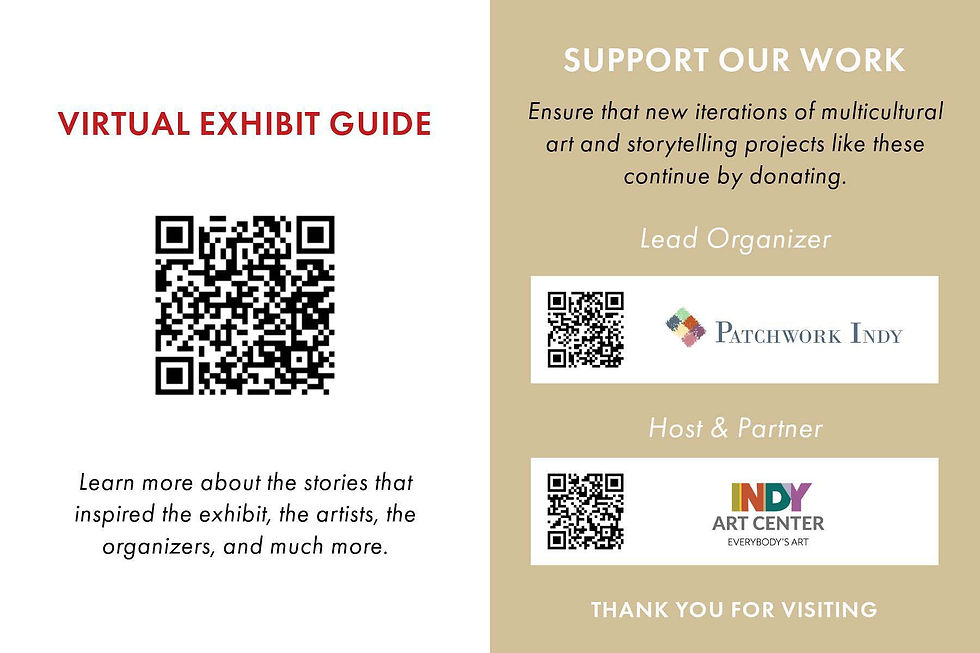
Through multicultural art exhibits, we at Patchwork Indy offered audiences the opportunity to experience foreign cultures in dialogue with one another that does not center on the American perspective, allowing viewers to understand their world as broader and more interconnected than it may seem.
For "Resistance to Cruelty that Never Ends," two Indianapolis-based artist-curators collaborated on an artistic juxtaposition of their cultures to gain a greater understanding of the spirit of resistance in the face of unrelenting odds.
The opening reception drew over 200 visitors, packing the Indy Art Center. The exhibit's marketing campaign reached over nineteen thousand in the Indianapolis metro area.
All branding and marketing pieces were produced by me.

IN THE MEDIA


Kite flying is a cultural staple in Afghanistan that became a symbol of resistance under the Taliban. Poems and notes of protest would be attached to kites and set loose to fly across towns and cities.

The "ï" is a Cyrillic symbol unique to the Ukrainian language. "ï"'s were painted on trees in Crimea during its occupation to show the Ukrainian spirit and its people persisted.
_Page_2_Image_0001.jpg)


Motion Graphics

Vertical


Article 31
Two Hoosier women share powerful firsthand stories of living under abusive landlords, highlighting the emotional, physical, and financial toll — and exposing systemic failures in renter protections.
Direction and Editing - André Guima
Cinematography and Color - Austin Keough
Producer - Greg Hurt II
Indy Film Fest 2025 - Best of Hoosier Lens Documentary Short
Bloomington International Film Festival 2025 - Official Selection
River Bend Film Festival 2024 - Official Selection
Two Hoosier women share powerful firsthand stories of living under abusive landlords, highlighting the emotional, physical, and financial toll — and exposing systemic failures in renter protections.
Direction and Editing - André Guima
Cinematography and Color - Austin Keough
Producer - Greg Hurt II
Indy Film Fest 2025 - Best of Hoosier Lens Documentary Short
Bloomington International Film Festival 2025 - Official Selection
River Bend Film Festival 2024 - Official Selection
Learn More
Learn More
More Than a 3D Print
A brand story video the that demonstrates all the care, craftsmanship, and caffeine behind every Zemlin Photo product.
A brand story video the that demonstrates all the care, craftsmanship, and caffeine behind every Zemlin Photo product.
Learn More
Learn More
A Refugee Story
Having gone through the multiple rounds of approval to be resettled, the Beverly and Beatriz Dyala spent over half a decade waiting for their turn to start again in a country with peace. Their three children have only known life in a refugee camp. But one day, Beverly got a call that would change his life.
They were one of the last families that got the chance to resettle in the United States through the Welcome Corps before the program along with the rest of the U.S. Refugee Admissions Program was paused indefinitely.
Having gone through the multiple rounds of approval to be resettled, the Beverly and Beatriz Dyala spent over half a decade waiting for their turn to start again in a country with peace. Their three children have only known life in a refugee camp. But one day, Beverly got a call that would change his life.
They were one of the last families that got the chance to resettle in the United States through the Welcome Corps before the program along with the rest of the U.S. Refugee Admissions Program was paused indefinitely.
Learn More
Learn More
CHIP Indy
Gregg Colburn discusses his groundbreaking book, "Homelessness is a Housing Problem," while in Indianapolis and discusses the city's looming crisis.
Gregg shares his research that challenges common misconceptions about homelessness and highlights the housing market's role in this crisis. Whether you are a policymaker, advocate, or community member, Gregg's insights are crucial to consider as we move collectively toward ending homelessness in the Indianapolis community.
Gregg Colburn discusses his groundbreaking book, "Homelessness is a Housing Problem," while in Indianapolis and discusses the city's looming crisis.
Gregg shares his research that challenges common misconceptions about homelessness and highlights the housing market's role in this crisis. Whether you are a policymaker, advocate, or community member, Gregg's insights are crucial to consider as we move collectively toward ending homelessness in the Indianapolis community.
Learn More
Learn More
It Takes a Village
Two women have an open and honest conversation on surviving child abuse and trying to heal from its unceasing traumatic after effects.
Finalist, Hoodox Pitchdox Competition 2023
Two women have an open and honest conversation on surviving child abuse and trying to heal from its unceasing traumatic after effects.
Finalist, Hoodox Pitchdox Competition 2023
Learn More
Learn More
Two Soles
In a world of pairs, Lenny the Left Sneaker finds himself in a toxic relationship until one day he decides to take big step into the unknown.
In the midst of the COVID pandemic, I led my team to create an innovative and award-winning film that explored social expectations versus individuality.
Indy Film Fest 2023 - Narrative Short Winner
Hollywood New Directors 2023 - Best Animation Short
Hoosier Films Annual Festival 2023 - Best Animation
Indy Shorts International Film Festival 2022 - Official Selection
In a world of pairs, Lenny the Left Sneaker finds himself in a toxic relationship until one day he decides to take big step into the unknown.
In the midst of the COVID pandemic, I led my team to create an innovative and award-winning film that explored social expectations versus individuality.
Indy Film Fest 2023 - Narrative Short Winner
Hollywood New Directors 2023 - Best Animation Short
Hoosier Films Annual Festival 2023 - Best Animation
Indy Shorts International Film Festival 2022 - Official Selection
Learn More
Learn More
Motion Graphics
Motion Graphics


